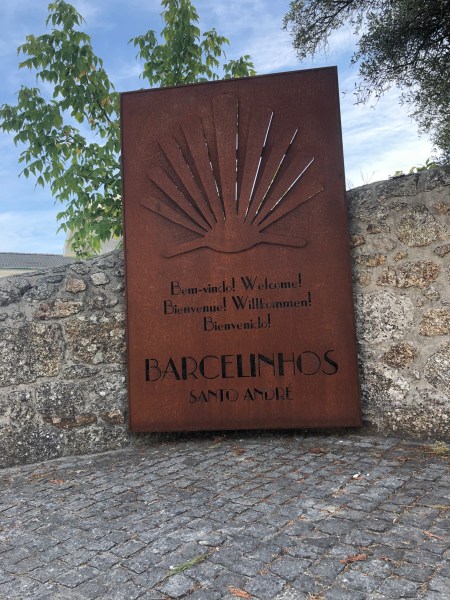
The Way – part 4: Arcos to Barcelos

It is 4 p.m. in Barcelos, a pretty town about 10 miles inland from the Portuguese coast. Tourism appears to be the town’s main business, with a lot of modern shops plying their wares in very old buildings. One of the town’s main attractions is an old Romanesque church, built in the 11th century. It is astonishingly beautiful.
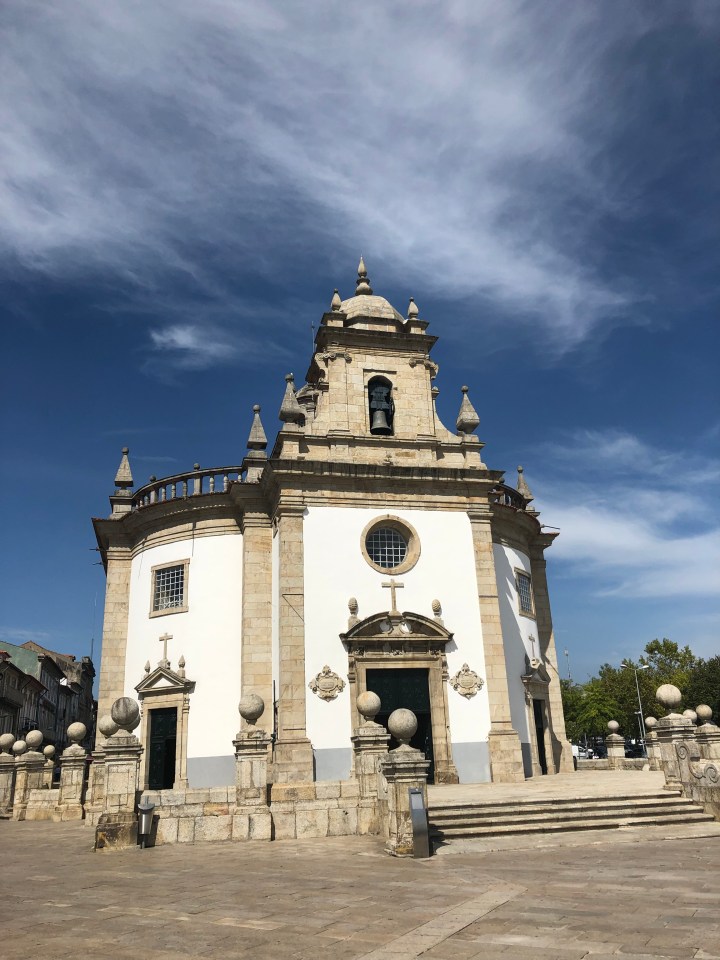
We arrived in town a little over an hour ago, shortly before 3 p.m. I was impressed that it seemingly took us less time to walk today’s 20 km than it did yesterday’s 17 km. We began our walk about the slammer time, and if anything, today’s walk was slightly hillier.

Of course, it was also much cooler today, with the temperatures for whole of the morning never breaking 20 Celsius. (I’m guessing, mind you. I don’t have a thermometer with me, and I didn’t see any temperatures displayed anywhere.)

The sun only burned off the cloud cover about an hour before we reached our destination, and even now my weather app says it’s only 22 C, about 8 degrees cooler than Arcos was when we arrived there yesterday.

All of this – the cloudiness, the cooler temperatures and slight dampness to the breeze – along with quieter traffic, by and large, made for a really pleasant walk.

We met more pilgrims on the road, too. A fellow from Ireland, an English couple, the group of Brazilian pilgrims who’ve befriended us along the way, and others, too.

The Brazilians are my favourites so far. So friendly, funny and outgoing. Only one of them, Carol, speaks any English, and neither of us can speak more than a few words of Portuguese, but we all seemed to manage together drinking wine in the courtyard of the hotel last night, and joking around at breakfast this morning. I’ll miss them when we eventually part ways.

The scenery today was even more interesting and impressive than yesterday, as cornfields yielded, here and there, to lush gardens with pear, apple, orange, lemon and lime trees, grape vines, roses, and flowers I can’t begin to name.

The houses, too, were frequently beautiful, especially in the Barcelos suburb of Pereira, where ultramodern casually coexists with medieval ruins, and many houses have small shrines built into their walls and fences.

We lunched in the village of Pedra Furada, named for a large stone with a hole in its centre situated outside an 18th century church. Legend has it that Saint Leocadia was buried alive, and escaped by drilling a hole in her erstwhile tombstone with her head.

Now we are getting ready to go explore Barcelos before dinner, abd then prepare ourselves for tomorrow’s 15 km walk to Balugães.

The Way – part 3: And… go! Porto to Arcos

Adele hiding from the camera behind a way marker.
Today the Caminho became a reality for us. Up at half past six, we had our bags (and ourselves) in the lobby two hours later, as instructed. Then we were driven through suburban and industrial areas not suited to walking, and dropped in the village of Mosteiro on the outskirts of Porto. After saying goodbye to our driver, we strapped on our packs and began the roughly 17 km walk to Arcos.

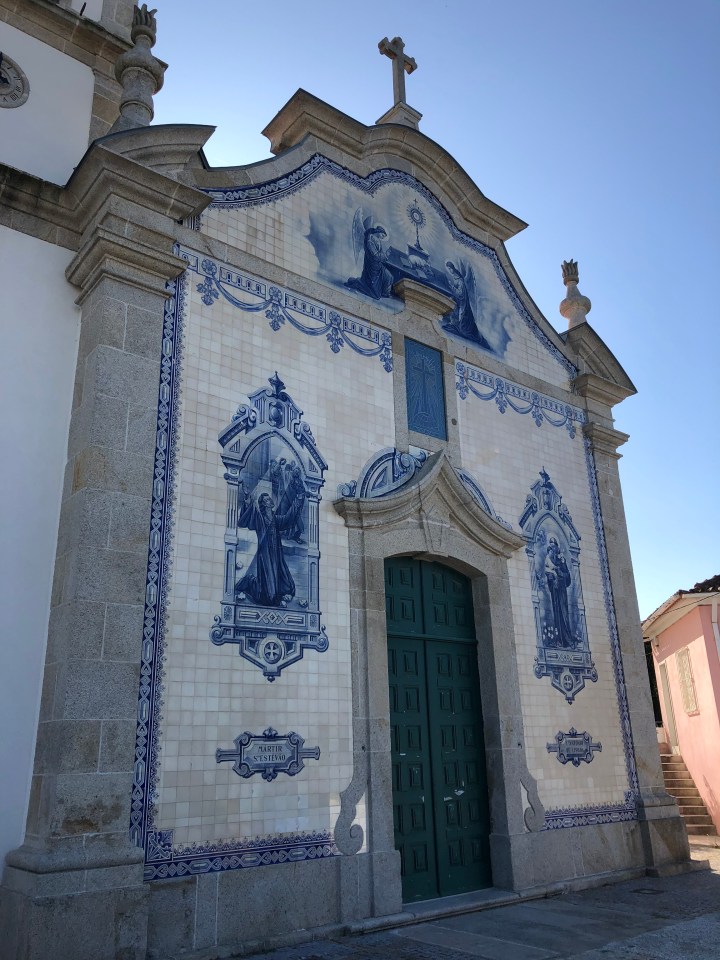
It was a bright, sunny morning, and the cobbled roads wound between tall stone walls interrupted every now and then by houses, their walls frequently decorated with blue and white tiles depicting saints, or scenes from biblical stories. We heard church bells announcing nine o’clock from towers in several directions.

We stopped at a small church dedicated to Santo Estavo (St. Stephen), in part because of its beautiful tile facing, and in part because a sign indicated “Public W.C.” After using the facilities (adjacent to the car park), we looked through the small cemetery. I’ve never seen so many elaborate grave markers in such a small space. As we were leaving, some fellow pilgrims, a group of six from Brazil, waved us over and told us that someone had gone to fetch a key so we could all look inside. It was astonishing, all the statues and decoration. I’m not religious, but it was impressive how much effort went into making and preserving this place.

We continued on between fields cornstalks a good seven or more feet high. The sun shone brightly and the morning warmed quickly. It was to become a very warm day for walking.

Cornstalks towering over Adele

By noon we reached the village of Vairao, which was a little beyond the halfway mark of our walk. We stopped at a churrasqueira near the town square for lunch. Nearly every table was already reserved, but the owner made room for us. The place soon filled with locals, and queue of others formed while we ate. Adele had BBQ chicken, and I ordered the fried octopus. The food was delicious, the staff were incredibly friendly, and it only came to €16.

The afternoon walk was hot. We went through most of our water, and stopped for lemon sodas about 3 km from Arcos. I’d made the decision not to bring my water pack, and I didn’t regret it. The added weight would have been a pain.

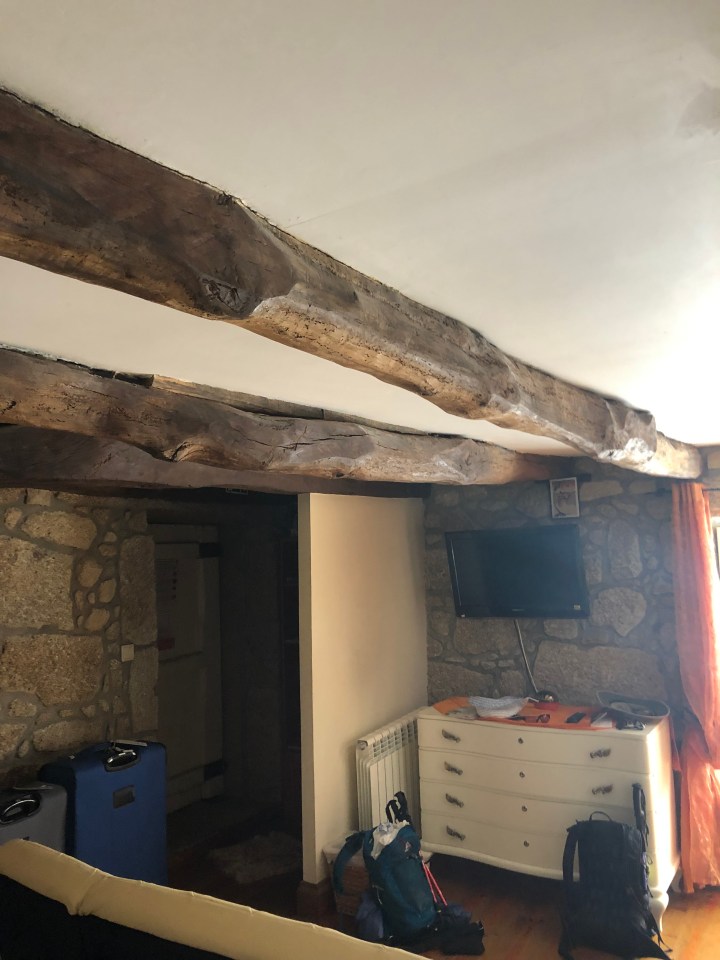
We arrived in Arcos about half past three. The Hotel San Miguel de Arcos is a beautiful place. With stone walls and wood floors. It’s a great place to end a day’s journey, and a blog post.

The Way – part 2: whirlwind in Porto

It’s nearing supper time in Porto, but Adele’s stomach is upset, likely from something she ate. The most likely suspect is the chicken club toasted sandwich she had for lunch, although I ate about a quarter of it and I’m feeling fine. Mind you, I have an iron gut (and a large one at that), so that doesn’t mean much.

We’ve met with the rep from Portugal Green Walks, and got our Caminho passports and guide books. I’ve rearranged my daypack, and am currently hmm-ing about whether or not to use the hydration pack. Pro: it’s going to be warm tomorrow (30ish Celsius). Con: weight. It might not seem like much to start, but after a while…. Mind you, I’ll be draining it as we go. Well, I’ll decide in the morning.

Happily, water is cheap here. I paid €4 for six litres. That’s about what I’d end up paying for one most places back home.

Prior to all of the foregoing, we spent the day touring Porto on one of those double decker sightseeing buses. Well, two of them actually. Anyway, although you can only skim the surface of a place that way, it showed us enough to think we’d like to come back for a longer visit at some point.

Tomorrow, though, we begin our Caminho. We have so many places to see, so many people to meet over the next couple of weeks, there’s no time to think about what we might do in years to come. We need to stay in the moment.

And at this moment, I’m starting to think about supper.

The way – part 1: Vancouver to Porto

Flying is something to be endured rather than enjoyed. Even on an ostensibly ‘good’ airline it’s an ordeal. The long indignities of the airport, with its random drug screens and ‘place all your belongings in the tray, yes, your belt, too’; the way you Get squeezed into the ever-shrinking confines of increasingly expensive seats, as they cram ever more passengers into each row; the lousy food (its never a good sign if you have to ask, ‘what is that?’, or when you’re told, ‘all we have left is vegetarian pasta’). If only it were possible to drive to Europe.

But here we are, in Porto. Only 24 hours after arriving at the airport in Vancouver. Of course, some of that time – about eight hours – was spent at the airport in Amsterdam. Luckily, we’d had the idea of booking a hotel room for about six of those hours. ‘Room’ might be generous. If was more of a pod, really. But it was perfect for what we wanted: a place to stretch out, have a quick nap and a shower. If you have a longish layover, I highly recommend it.

It’s hard to say what Porto is like yet, as it’s dark. But it’s quiet, and the few people we’ve met so far have been friendly, and enthusiastic about their city and country.

The hotel here is more than acceptable. I’ll write more tomorrow.

Ready, set, ….

The preparations are done. The BBQ has been cleaned & brought in for storage. The house is closed up. Our bags are packed. We’ve checked in for our flight.

In a few hours, we’ll be in our way. Porto via Amsterdam, then the long walk to Santiago de Compostela. A pilgrim route. And maybe a sort of pilgrimage, too, if not a religious one. A journey of discovery, and of celebration.

I don’t know what I hope to find. Some of it will have to do with places we stop and the people we meet along the way. Some of it will be things we learn about ourselves. Traveling reveals so much about the traveler.

The celebration is less uncertain. It has to do with my continuing life with Adele. We’ve known each other for 28 years, lived together for 27, been married for a little over 25. It amazes me that two people can be together so much and for so long, and still love each other.

It often felt as though we’d never get to this day. There were so many months between the first idea of this journey and this moment. So many things we had to do to prepare. So many tasks that had nothing to do with it, but that we’ve had to do before going: at work, at home. Life seems always to get in its own way.

But here we are, finally, at the starting line: ready and set, and waiting to go.

Cosmology — fragments

say the world is filled
mainly with emptiness

gaps
between trees

space
between stars and planets
atoms and particles

tiny fragments
of presence
surrounded by absence

sounds break up silence
into song, measured and measurable
ordered on mathematical principles
numbered and arranged
in defiance of zero
of nothing
of space

vain desire that there be
something rather than nothing

lonely beauty of a dying star
on the remote edge
of a galaxy
a billion light years away
spinning and whirling
on the edge of annihilation
dancing and singing
its brief being
into the void

is it just a habit of mind
this conflict between something and nothing?
Manichaean tendency to believe
that everything requires an opposite?
polarizing instinct to divide
rather than blend?

say
we are atoms thrown defiantly together
we are particles cast out from stars
we are energy
time and motion

and when our time is done
cast off again
thrown together again
reused and recycled

old notes for new songs
new arrangements of old harmonies

in the end there is silence

that music had a dying fall
but does nothing follow?

the musicians put away their instruments
the audience departs, the hall is empty

say there will be other songs, other performances
other musicians and audiences

say each performance will be something new
or a remembrance of something that never was
and never will be again

maybe it’s a failure of imagination
that I don’t believe

in angels or gods, or
feel a connection to something beyond

that I don’t fill emptiness with purpose
suppose that planets have plans for me
or that they rest on spheres moved by celestial harmonies

that the inert remembers
the briefly living, that there is justice
more satisfying than dissolution

although I sometimes hope for a thread of memory
stitched into a corner of the fabric of time

I do not know how things begin
or end, or even if

or say
beginning and end are one and the same
seen from different angles

a lone whale sings her grief
to an almost empty ocean

in the middle of Ireland
stones still hold the shape
of an old church
carved and carefully stacked
into walls defying entropy
which has already claimed the roof
ruined the choir
where now even birds are not singing

other stones remember
lives no one recalls
history does not remark

only a fugitive cow grazes in the long grass
honeybees stir the pestles of wildflowers in the shade of a stone wall

and I have stopped to capture a moment in a photograph

how much longer will these stones cling to each other?
to the idea of order that placed them here?
how long can names and dates resist the wind and rain?

one year and eight hours away
I sat on the bench near my father’s stone
having cleared away the encroaching grass
and dirt that filled in the letters
of his name

and I spoke to him as if he were alive
spoke in a way I never did
while he was alive

I spoke as if he could hear me
as if it were a prayer

the wind stirred the leaves in the trees
and brought the rainclouds closer

somewhere a bird sang
a melody I couldn’t follow
and a hare stopped briefly
to consider my presence
then carried on with his day


© Mark Milner, Burnaby, BC, July 2019

Backing and forthing

It’s been a long time since I wrote anything on this blog. Being busy isn’t really much of an excuse. It’s not like there haven’t been hours wasted each day that I could have spent doing something productive. If this is, in fact, productive. For the most part, I think of it was talking to myself on (virtual) paper – a way of sorting through the flotsam of my mind, and trying to make some sense of it all. It’s been a strange few months.

A good friend of mine, who I’ve known for more than 30 years, has moved more than 7,000 km further away than he was previously – from Calgary to St. Petersburg, Russia. While I’m excited for him, and support his decision to leap into the unknown, what I feel mainly is loss.

In the past 25 years, since I moved back to the west coast, we’ve really only seen each other two or three times a year, at most, and rarely spoken on the phone more frequently than that. And yet, I’ve always felt a closeness, like kinship, to Scott. He was the best man at my wedding. He’s always been there when I needed him, and I’ve tried to do the same for him.

That he’s no longer an 80 minute flight, or 11 hour drive, away feels strange. To visit him now will not be as simple as booking holiday time and a flight. It will require planning. I’ll need to get a visa, for example, and won’t really be able to book anything until I have one. None of this is insurmountable, of course, and I can’t help feeling I’m being entirely selfish in focusing on this as a problem rather than an opportunity.

And yet, it still feels like loss. Scott was the first of my close friends to ride a motorcycle, and one of the last, too. Most others had given up already. My first long road trip on a bike was with Scott. We rode down the west coast and into the desert. We rode through eight western U.S. states and two provinces in twelve days. By the end of it, motorcycling had become part of my identity.

I’ve done two long trips since then, and numerous shorter rides. One trip, with another friend, who later gave up riding after a crash, expanded on that first adventure. Twelve states in 21 days. And then last year, I rode solo around Ireland and the UK for three weeks.

Since that last trip, though, I’ve barely ridden at all. A handful of short rides last summer and early fall. Nothing really since then. In part, it’s likely to do with not having many people nearby to go out riding with. But mainly, I just haven’t been motivated to do it. Riding in traffic has become a drag, and there just aren’t that many good routes nearby that I haven’t already done, in many cases multiple times. There’s certainly nothing on the level of the roads in Ireland and Scotland. And so, with all that, I’ve put my bike up for sale.

This, too, feels a little bit like loss, although it was entirely my own decision. Seeing my bike in the garage every day, and not really feeling the urge to ride it, was beginning to bother me. Keeping it insured and maintained, but not riding it, seemed like a waste. It’s a great bike. It deserves to be ridden.

I think, more than the annoyances of traffic and the declining number of fellow riders in my circle, my identity began changing last year. I started to think of myself more in terms of playing music than in terms of riding motorcycles.

I’m not very good (yet) at playing music, but I’ve improved quite a bit over the past year. I’ve now got a collection of five instruments – two bass guitars, an electric guitar, an acoustic, and a keyboard synthesizer. Where my YouTube stream used to be filled with motorcycle videos, it’s now full of music-related things.

Are my motorcycling days done forever? I don’t know. It’s entirely possible that I’ll want to do more long trips in the future. Or that a period away from it will reignite the passion I used to feel. We’ll see. For now, though, I’m indulging other interests.

And of course, Adele and I are preparing for our pilgrimage. Dates in calendar are often closer than they appear. We’re just over two months from flying off to Portugal, and then walking to Spain. If I weren’t me, I’d be jealous.

I expect a lot will happen between now and then. Locally, Bard on the Beach has begun it’s 2019 season. We’ve seen Taming of the Shrew (which was brilliant!) and have two more plays coming up this month, and one in August. We’ve also recently seen the Claypool Lennon Delirium – one of the best rock shows I’ve experienced – and have tickets coming up for The Raconteurs, ZZ Top and Iron Maiden (although Adele has already said I should find someone else for that one). Add to that the walking we need to keep doing, the songs I want to learn, the books to read… And… and… and….

Well, this has been a bit of a pointless ramble. My apologies if I’ve wasted your time. But it was your decision, as much as mine, to keep going. If you expected there to be a point to all this, whose fault was that? But I’ll tell you what: I’ll try to do better next time.

Pilgrimage

As I’ve mentioned before, I’m not a religious person. I don’t believe in gods or spirits that are disconnected from bodies, or souls that survive after a person dies. I believe we are physical beings, with an all too finite span of existence, and that what many people call a soul is really just a part of mind or personality. Of course, I could easily be wrong about this, as is the case with any belief, but I haven’t seen any evidence or argument that has convinced me that I’m in error.

And so it may seem strange that I will be making a pilgrimage this year. Not just a journey that has personal meaning, but an actual pilgrimage. Later this year my wife and I will walk one of the several official pilgrim routes to Santiago de Compostela – known at one time as a ‘way of St. James’, as people once believed (and some may still) that the remains of St. James were located in Santiago. Leaving aside the vast amount of historical fraud associated with so-called relics, pilgrimages of this sort have been popular in Europe since the Middle Ages, and many people of more religious bent still embark on such journeys – and the Camino, in particular – for religious or ‘spiritual’ reasons. For me, however, this will be a very long walk through places I have yet to visit, where I hope to meet many people, encounter new foods and wines, new music and art, expand slightly my meagre linguistic capabilities, and learn more about myself.

I have long been of the opinion that walking has benefits that other forms of mobility do not. The physical benefits are obvious and well known – and something I can use more of in my far too sedentary lifestyle. In addition to those, walking (if done right) helps to clear the mind and improve our ability to attend to the world around us, in a manner that other, faster forms of travel preclude. The faster you move, the less you take in, and the less time you have to think about and absorb the information around you. If you really want to know a place, you need to walk it.

Before we travel to the start of our journey, we’ll spend more time walking in our own, more familiar environment. We need to get used to walking more than 10 km – usually 15 to 20 – every day, if we expect to be able to walk the 240 km route we have planned in two weeks. So, over the course of the spring and summer, we’ll begin walking more, building up to the distances we need to able to cover. In doing so, not only will our physical health likely improve (did I mention I spend far too much time sitting?), but I expect we will come to know our home town, and ourselves, in new ways.

If anyone has done a similar journey, please let me know about it in the comments. And if you’ve blogged about it, send me link.

Stones

In the middle of the city
a field of carefully arranged stones
is calling out.

One stone in particular
calls to me
across mountains
quietly as a whisper
of wind in short prairie grasses
or snow sloped
gently against fenceposts.

There are few of us here
tending to the stones, clearing
the snow and the dead
overgrown grasses and cold
dirt from their faces.

Even though I have memorized the place
it still takes a few tries to locate the right one.

And then it is there.
My father’s name emerging

and the dates
always surprising me
with how many years it’s been now.

The quiet of this place,
this snowy field of stones, where names and dates drift
out of memory. How many years before this is all that is left of us?
Who will visit on a winter’s day
to brush the forgetful snow from our names?

We turn away from the thought.
I say goodbye to the stone.
I promise to return.

© Mark Milner, 2018, Vancouver

Loss in the supermarket

This poem grew out of a story my cousin-in-law (that’s a thing, right?) posted on Facebook. It stuck in my mind, as some things do, where it got reshaped (not to say warped) as everything tends to. This is for her, and her son.

Loss In The Supermarket

a woman and her young son
are in the supermarket
looking at steaks when the boy asks
are those dead cows?
and the woman answers, yes
and the boy asks
why are they dead?

before she can answer
a man nearby says, because they’re delicious

she doesn’t tell the boy this is wrong
or at least, not entirely right
she doesn’t tell him that everything dies
and some things that die are eaten
she doesn’t say that the cows were always
going to be food (and shoes and jackets and
baseball gloves) and that some people think that’s wrong and others think it’s delicious

she doesn’t say the cows
(and pigs and chickens)
only exist to be cut up and shrink
wrapped on styrofoam trays

she doesn’t say that someday she
will fade and fall like the leaves that litter
the lawns on their street, and that
so will he and so will his older brother
and their father, too

and everyone they know
who doesn’t come
to a more unseasonable end

she doesn’t talk about
the hospital where she works
about the overflowing cancer ward
that his grandfather has survived
twice now

she doesn’t say there is really no surviving
but only temporary reprieves

she hopes he will not learn this too soon

she chooses her steaks and smiles to him
should we buy ice cream for dessert?

© Mark Milner, 2018, Vancouver