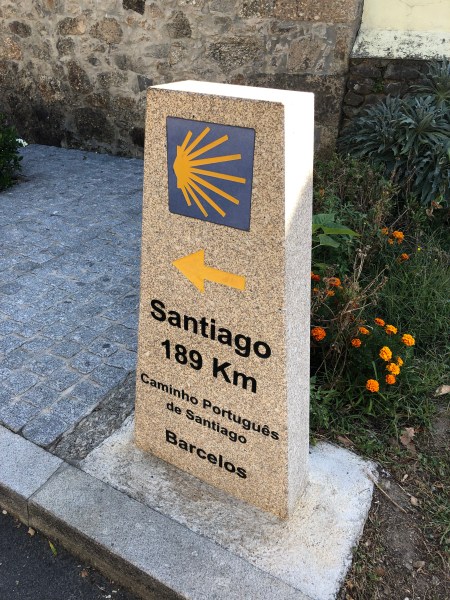
The Way – part 5: Barcelos to Balugães

Today was a relatively short walk: only 15 km, and mostly flat, rural and often picturesque, with moderate temperatures under mostly clear skies.

We woke early, and in my case often, as I found it nearly impossible to get comfortable on a bed that was too narrow, too short and too firm. And it may be that my dreams were disturbed by visions of oversized polychromatic roosters, like those I’d seen everywhere in town. I had begun to wonder, as we wandered around town, if Barcelos was the centre of strange chicken cult.

When I tried to pst this picture on Facebook, they wouldn’t allow it. Perhaps it violates a rule about cock shots?

It turns out I wasn’t far wrong, and that the legend of the rooster is integral to not just Barcelos, but also to the national identity of Portugal. It also has ties to the Caminho. A pilgrim from a neighbouring village was sentenced to death, but told the magistrate that, as proof of his innocence, a rooster – one the judge had planned to eat that night – would crow at the moment of his hanging. Skeptical, the judge nevertheless set the bird aside. And just as the pilgrim had foretold, the cock began crowing as the innocent man was led to the gallows. The judge ran to save the pilgrim, who later returned and sculpted a cross in honour of St. Mary and St. James, whom he believed had interceded on his behalf. The cross is known to this day as The Cross of the Lord of the Rooster.

Of course, I don’t recall anything quite so elaborate from my dreams. In fact, I don’t recall them at all, and it may be that there were no roosters haunting my sleep. I can’t say.

At any rate, a short time after waking, we went up to the free hotel breakfast, and by nine we were on the road.

The Way wound through the outskirts of town and into a countryside of rolling hills, stone walls, cornfields, vineyards, and the occasional small village. It was prettier than the previous days, with more narrow dirt lanes mixed in with the ubiquitous cobblestones and the less frequent tarmac.

We made good time, in spite of an unhurried pace. We chatted for a while with a German couple from Reims who walked with us a few kilometres, and who told us the corn we saw growing everywhere was for fuel rather than food. We also talked later with some Americans at a bus shelter on the edge of the village of Tamel. We offered them our sympathy for their president, and they said they hoped he would soon be replaced. We said we hoped so too.

It was a little before one that we checked into our hotel in Balugães, a small, pretty village surrounded by farmland.

The hotel is beautiful. A walled courtyard with multiple buildings, and best of all, four resident cats. It’s been a good day for us regarding animals. We’ve seen many dogs and cats, and got to pet a beautiful, old black lab while trying to have a conversation with its owner, who didn’t speak any more English than we do Portuguese.

Our room has a king sized bed, stone walls, concrete floor, and very modern conveniences. The courtyard has lime trees scattered around the plush lawn, stone walkways, and numerous places to sit & drink beer.

Tomorrow we leave for Ponte de Lima, a larger town 18 km from here. But for now, sitting in the cool twilight sipping a Cristal and trying to tempt the cats closer is the moment I’m happy to be in.
The Way – part 5: Barcelos to Balugães

Today was a relatively short walk: only 15 km, and mostly flat, rural and often picturesque, with moderate temperatures under mostly clear skies.

We woke early, and in my case often, as I found it nearly impossible to get comfortable on a bed that was too narrow, too short and too firm. And it may be that my dreams were disturbed by visions of oversized polychromatic roosters, like those I’d seen everywhere in town. I had begun to wonder, as we wandered around town, if Barcelos was the centre of strange chicken cult.

When I tried to pst this picture on Facebook, they wouldn’t allow it. Perhaps it violates a rule about cock shots?

It turns out I wasn’t far wrong, and that the legend of the rooster is integral to not just Barcelos, but also to the national identity of Portugal. It also has ties to the Caminho. A pilgrim from a neighbouring village was sentenced to death, but told the magistrate that, as proof of his innocence, a rooster – one the judge had planned to eat that night – would crow at the moment of his hanging. Skeptical, the judge nevertheless set the bird aside. And just as the pilgrim had foretold, the cock began crowing as the innocent man was led to the gallows. The judge ran to save the pilgrim, who later returned and sculpted a cross in honour of St. Mary and St. James, whom he believed had interceded on his behalf. The cross is known to this day as The Cross of the Lord of the Rooster.

Of course, I don’t recall anything quite so elaborate from my dreams. In fact, I don’t recall them at all, and it may be that there were no roosters haunting my sleep. I can’t say.

At any rate, a short time after waking, we went up to the free hotel breakfast, and by nine we were on the road.

The Way wound through the outskirts of town and into a countryside of rolling hills, stone walls, cornfields, vineyards, and the occasional small village. It was prettier than the previous days, with more narrow dirt lanes mixed in with the ubiquitous cobblestones and the less frequent tarmac.

We made good time, in spite of an unhurried pace. We chatted for a while with a German couple from Reims who walked with us a few kilometres, and who told us the corn we saw growing everywhere was for fuel rather than food. We also talked later with some Americans at a bus shelter on the edge of the village of Tamel. We offered them our sympathy for their president, and they said they hoped he would soon be replaced. We said we hoped so too.

It was a little before one that we checked into our hotel in Balugães, a small, pretty village surrounded by farmland.

The Way – part 4: Arcos to Barcelos

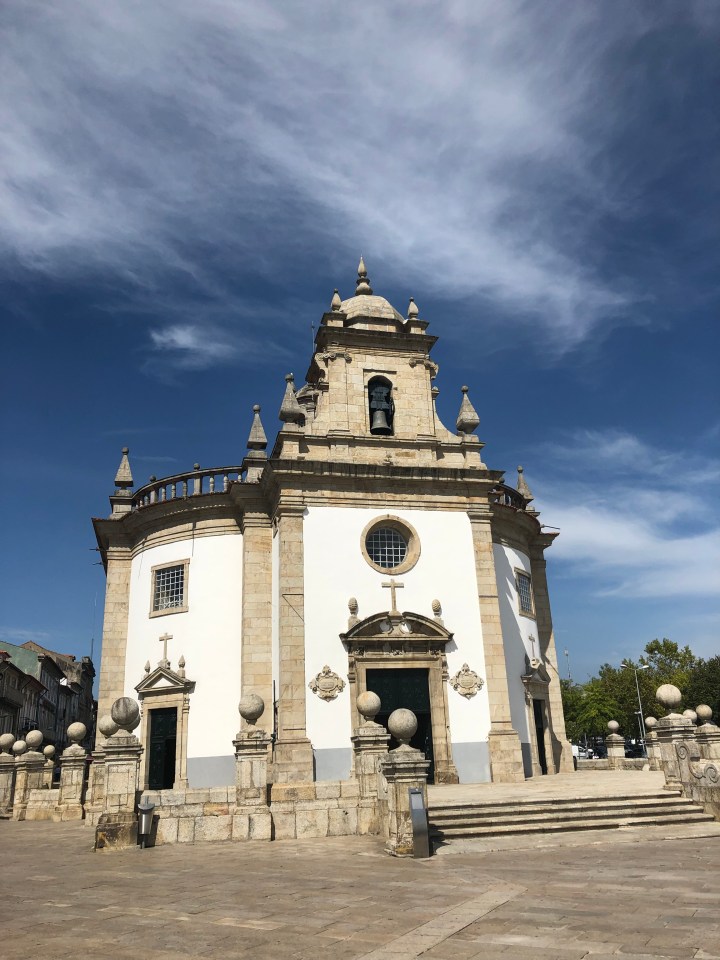
It is 4 p.m. in Barcelos, a pretty town about 10 miles inland from the Portuguese coast. Tourism appears to be the town’s main business, with a lot of modern shops plying their wares in very old buildings. One of the town’s main attractions is an old Romanesque church, built in the 11th century. It is astonishingly beautiful.

We arrived in town a little over an hour ago, shortly before 3 p.m. I was impressed that it seemingly took us less time to walk today’s 20 km than it did yesterday’s 17 km. We began our walk about the slammer time, and if anything, today’s walk was slightly hillier.

Of course, it was also much cooler today, with the temperatures for whole of the morning never breaking 20 Celsius. (I’m guessing, mind you. I don’t have a thermometer with me, and I didn’t see any temperatures displayed anywhere.)

The sun only burned off the cloud cover about an hour before we reached our destination, and even now my weather app says it’s only 22 C, about 8 degrees cooler than Arcos was when we arrived there yesterday.

All of this – the cloudiness, the cooler temperatures and slight dampness to the breeze – along with quieter traffic, by and large, made for a really pleasant walk.

We met more pilgrims on the road, too. A fellow from Ireland, an English couple, the group of Brazilian pilgrims who’ve befriended us along the way, and others, too.

The Brazilians are my favourites so far. So friendly, funny and outgoing. Only one of them, Carol, speaks any English, and neither of us can speak more than a few words of Portuguese, but we all seemed to manage together drinking wine in the courtyard of the hotel last night, and joking around at breakfast this morning. I’ll miss them when we eventually part ways.

The scenery today was even more interesting and impressive than yesterday, as cornfields yielded, here and there, to lush gardens with pear, apple, orange, lemon and lime trees, grape vines, roses, and flowers I can’t begin to name.

The houses, too, were frequently beautiful, especially in the Barcelos suburb of Pereira, where ultramodern casually coexists with medieval ruins, and many houses have small shrines built into their walls and fences.

We lunched in the village of Pedra Furada, named for a large stone with a hole in its centre situated outside an 18th century church. Legend has it that Saint Leocadia was buried alive, and escaped by drilling a hole in her erstwhile tombstone with her head.

Now we are getting ready to go explore Barcelos before dinner, abd then prepare ourselves for tomorrow’s 15 km walk to Balugães.