Meta bollocks

You have to love social media. A friend (cousin, actually) posted, as a joke, a hilarious video of some whacked out conspiracy theorist talking about AI and vaccines and quantum entanglement — managing to get all three wrong. I commented, “where can I get those drugs?” Because only someone on a crazy trip could be so delusional.

Within seconds, Facebook notified me that my comment had been removed for violating “community standards”. They thought my comment somehow promoted the sale of illicit drugs.
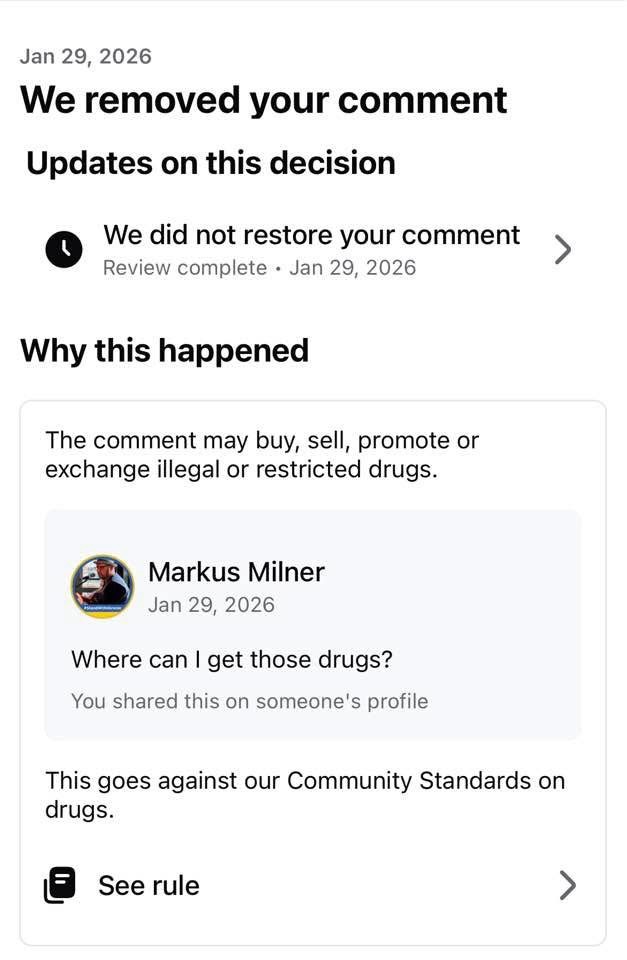
What humourless community came up with these standards? And who allowed them to train Facebook’s model?

Their notification offered me the option of having my comment reviewed. I took them up on that. “You misunderstood my comment,” I selected from the list. On the next screen they provided another list. I chose, “It was a joke.”

A few seconds later, I was advised that they were putting restrictions on my account. I am not allowed to create ads, start or join calls, or create live videos for a month. All because their shit algorithms took offence to what I said, and further offence to my request for a review.
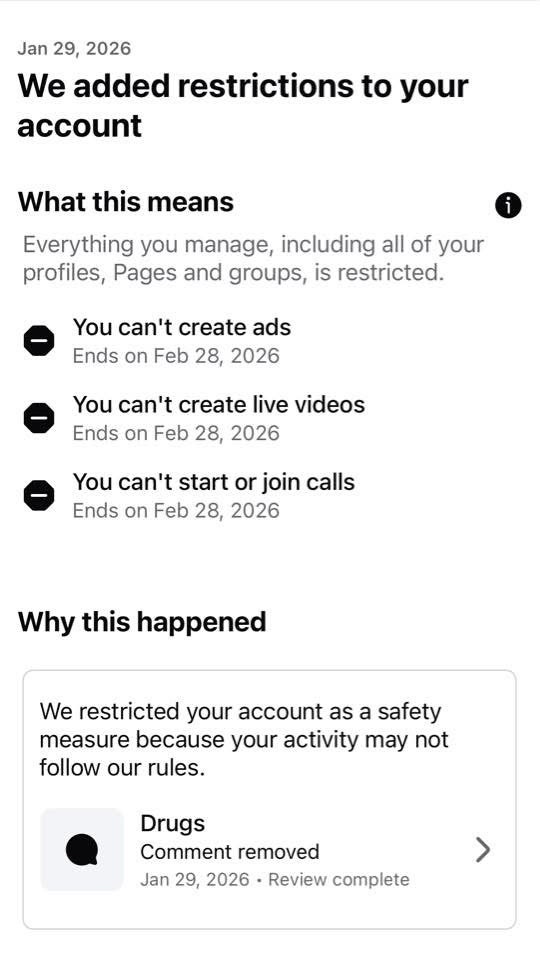
There is no option to appeal beyond this point. The algorithm has found you guilty, and that’s that.

This might be less galling were it not for Facebook’s role in spreading the kind of disinformation that makes cooks worry that quantum entanglement will trigger the nano bots implanted by vaccines when in the vicinity of a 5G signal. And that is hardly the worst of what they do.

Once upon a time, Facebook and other social media platforms at least pretended to be about sharing with people with whom you choose to associate. But it’s rare to see anything posted by someone you know. The majority of the slop in our feeds is advertising, and much of it promoting disinformation.

The only reasons I have accounts are to (try to) keep up with friends and family I don’t have an opportunity to see face-to-face all that often, and to promote my band. Otherwise, I would kick Facebook, Instagram & every other platform to the curb. I’ve done that before, and it may come to it again.

What is the business of business?

Let me begin by saying I am not an expert on business. I’ve never owned a business. I have managed one, and worked for several, and even been a business analyst – but none of that makes me an expert. I’m also not an economist or a political scientist. So, take the following with as large a grain of salt as you feel appropriate. (My apologies if you already suffer from hypertension.)

When most of us think of the purpose of businesses – to the extent that we think of such things at all – I expect we imagine that said purpose is to produce goods or provide services. These goods and services are priced so that the business owners can recover their costs, and hopefully make some money over and above that. That additional money – a.k.a., profit – provides the business owner with an income, and perhaps allows them to expand their business, and so produce or provide more goods and services. This expansion may require them to employ helpers. This is a pretty simple, perhaps overly simple, description of what the business of businesses is. It’s likely an apt enough description of the business of many very small businesses. Piano tuners, bobcat operators, bakers, and so forth.

Of course, not all businesses are small, and the business of many businesses has become the generation of profit pure and simple, and any production or provision of goods and services is really incidental to that. When you think of very large companies, they tend to have many diverse ‘lines of business’. These may include everything from breakfast cereals to herbicides to life insurance, or the transportation or sale of such. The ownership of such large enterprises tends to be very diverse, such that some of the owners are also companies – hedge funds, pensions, etc.

Neither of these types of business has any necessary relationship to or dependence on political or economic systems, such as democracy or capitalism. Businesses existed before either of those were formalized. They can exist in fascist or communist countries just as easily as democratic or capitalist ones. Democracy and capitalism may or may not be good things, but they have little bearing on the success or failure of businesses.

Even profit does not have much to do with politics or economics. People made a profit centuries before capitalism or democracy, or any of their modern alternatives, existed. I’m fairly certain they will continue to make money, or whatever signifies wealth, in whatever systems come afterwards. I’m not even sure that profit for profit’s sake is really all that new. There have always been frauds, conmen, forgers and hucksters – and others – whose motives had more to do with greed than anything else.


There is nothing necessarily right wing, conservative, reactionary – or whatever term you prefer – about business and profit. They are not incompatible with progressive, left wing, or even socialist regimes. (The same thing goes for taxation and government spending, but I’ll leave that for another time.) You can be right wing and an enemy of business, for example, by implementing immigration policies that make it difficult for companies to hire workers, or by taxing necessary imports. In the same way, you can be left wing and supportive of universal health care or child care programs that may contribute to increased productivity. There is nothing necessarily progressive about making it difficult for businesses to succeed, just as there is nothing necessarily conservative about keeping wages low.

But all of this begs the question, what is the business of businesses? Is it just about profit, and the maximization of profit? Or is it about producing goods – bread, say, or books – or providing services – music lessons, or project management? My personal preference, of course, is for the latter. For true entrepreneurialism – or what I like to think of as the real deal – and enterprises with a human scale, and a human purpose. Am I wrong? Is bigger really better?

If there are any experts who read this, maybe you can let me know.

Ideas for possible future blog posts

50 Shades of Beige (or, life in a corporate veal pen)

Two Wheels, or Not Two Wheels? (Definitely the former)

Back to bass-ics 

Strung out (or misadventures of a middle-aged guitar novice)

Today in Not-politics: 500ish words that have nothing to do with Trump

…shall inherit the earth

I am a relatively lucky man. I don’t have a lot of material wealth, but I do have more than a lot of people. I have more people in my life who I love than I can count on both hands, to borrow a line from Pearl Jam. I’ve even managed to keep a number of those relationships alive for more than two decades. My health isn’t perfect, but my end date is an open question, not something I can see rushing toward me at a defined pace.

Not everyone can say these things, and despite the conventional wisdom that everything is about choices and attitudes, it’s often not their fault. For some people, none of the options available to them are good, and no amount of positive thinking will change that.

We don’t like to think about ‘the poor’ in our society, and when we do, we prefer to assume their fate was a result of their own character flaws or poor choices than the inevitable outcome of our social structures. We like to dismiss the homeless and the poor as lazy and/or stupid, because it absolves us of any responsibility.

This is a strange position to take for a society that likes to think of itself as Christian. When you consider how wealth and poverty are discussed in the Gospels – that the poor get to inherit the earth, that the rich have less chance of entering heaven than a camel does of passing the eye of a needle, and so on – it’s difficult to fathom how we can be so blasé about the misery of others. Of course, someone will point out that ‘the poor shall always be with you,’ but I don’t think that statement was meant to excuse the rest of us from trying to make their lot better.

Now, as I’ve stated before, I’m not a Christian (or an anything, for that matter), and further, I’d prefer our society – or at least our institutions – to be secular. But whatever your religious persuasion (or, if you’re like me, unpersuasion), it seems socially important that we try to do a better job of looking after each other.

Currently, our western societies seem to be moving in the opposite direction. (No eastern societies are doing any better in that regard, as far as I’m aware.) We retreat into looking after ourselves, and maybe the small cluster of people we surround ourselves with. The Ayn Rand Virtue of Selfishness crowd seems to have largely won the day, at least for now.

There are some, of course – of many religious and non-religious stripes – who do try to help those whose boats have been swamped by the ebb and flow of economic tides. They volunteer at food banks and soup kitchens. They collect and hand out blankets and socks. They do so much, but it is never enough. Can never be enough.

Poverty is the cancer caused not just by our economic systems, but the way we have structured our societies. It grows and spreads. Charity is like chemotherapy trying to keep some of the tumors at bay, at best, like an opioid to dull the pain at worst. Charity cannot prevent poverty, or make the pain of it slightly less intolerable.

Is there a way to change this? To prevent poverty, rather than ‘treating’ it? I don’t know. I like to think there is, even if I can’t describe it myself. I’m pretty certain, though, that it won’t come from more Randian selfishness, or from any amount of charity. Marx thought he’d found a solution, and I think he was right in assuming it required democratization of economics, but his method – at least as it’s been executed historically – hasn’t worked out any better than Christianity.

If anyone’s got some serious ideas how to go about this, please speak up.

Odds & sods

Strange days in politics…. I mean even more than usual.

In the U.S., Donal Trump talked mostly about himself in relation to Black History Month, with a nod to the little known up & comer Frederick Douglass (oh, my!), apparently unaware of the 19th Century abolitionist and friend of Abraham Lincoln. Turns out the Donald threatened the President of Mexico with invasion and told off the Prime Minister of Australia before hanging up on him. I don’t think this bodes well for the upcoming visit with Canadian PM Justin Trudeau.

Speaking of whom, here in Canada our Prime Minister has abandoned his election promise to reform the electoral system his party subsequently benefited from to one that better reflects the popular vote. I guess when you go from third place to first, your perspective changes. Funny, that. I’d be more disapppointed if I’d fallen for the lie.

Add that to his ‘betrayals’ (utterly predictable though they might have been) of the progressive voters who abandoned the NDP for the Liberals in the last election, such as on oil pipelines, greenhouse gas emissions targets, pulling out of combat in Syria, and so on. Add all of that to his cash for access fundraisers, holidays with religious leaders whose charitable foundations get millions of federal dollars….

For those Bernie-loving Americans who think our Liberal Prime Minister is some kind of progressive poster boy, think again. He and his party are just as inextricably linked to big business as any establishment politicians in the U.S.

****

Still too cold, in my opinion, to be out and about on two wheels. I just don’t like frost and ice. I can’t wait for the overnight low temperature to get up to 3C again!

****

Reading Guitar Zero (which could be my new nickname) by Gary Marcus. It’s a fascinating book, even if you’re not trying to learn to play an instrument. (And reassuring if you are. It’s not so much that you’re talentless as that this really is difficult! Eventually, with enough practice, you’ll get better at it. Probably.) It looks at how learning a musical instrument rewires the brain, even later in life. Well written, well researched. If you’re interested in neuropsychology or music, or language for that matter, I recommend it.

****

Cat is being high maintenance, so that’s all for now.

Playing the Trump card

Many years ago, an American rabbi published what would become a self-help bestseller called When Bad Things Happen to Good People. The book was intended to help people get past unfortunate events in their lives, and not become defined by those events. Right now, I think what is needed is a book called When Good People Do Bad Things. The purpose of this book would be to explain how ordinarily good people brought themselves to vote for Donald Trump.

The inauguration of that lumpen orange narcissist is only a little over a week away. All over the world (with the possible exception of Russia), people are asking how this could happen. How could any sane, halfway moral person justify to himorherself the notion of ‘President Trump.’

Now, I will grant you, Hillary was hardly the best choice of candidate for the democrats, or any other party for that matter. I would much rather have seen Bernie or Biden, myself. Or any number of women. Gender is not the reason I didn’t particularly like Hillary. Neither were emails or Benghazi, or any of the muck the republicans tried to throw at her. I didn’t like Bill that much, either, although it had nothing to do with Monica, and everything to do with economic policy. And it was, again, economics, and the sense that both the DNC and Hillary herself thought ‘it was her turn’, that made me prefer other options to the former Secretary of State.

Having said that, I would have preferred the election of nearly anyone – even the return of George W. Bush, never mind little Jeb – to the smirking misogynist about to occupy the Oval Office. (And I definitely would have preferred Hillary to either Bush.) The only person in the running who may have been as unfit for office as Trump was Ted Cruz, thankfully now a political has-been.

So how did they do it? Ordinary middle Americans. Salt of the earth types. Church and BBQ types. People who I wouldn’t have expected to cros the street to spit on a New York billionaire. How did they bring themselves to vote for such a creep? Such an obviously crazy, frequently bankrupt, don’t leave him alone with your daughter or your savings account creep.

A lot of people say it was racism, and I don’t doubt there was some of that. Too many confederate flags at Trump rallies, too many swastikas painted on walls since the election, to think otherwise. But I don’t think racism could possibly have motivated that many voters.

Some others say it was about economics. Not that anyone, including Trump voters, believe he has an economic plan at all, never mind a good one. But that the economy that has been foisted on Americans, and that has taken their jobs, their homes and, worse, their dignity over the past 37 years, if not longer, had finally made them stand up and say, ‘no more.’ There may be something to that.

The so-called ‘left’ in America bailed out banks while they foreclosed on families. They bragged about economic recovery, even as the divide between rich and poor grew, and careers you could support a family with were replace with jobs with low pay and no security. Or with no jobs at all.

Anyway, I look forward to an explanation that isn’t too easy, or too comfortable for those who lost. I hope America – and France, the Netherlands, Germany, and Britain, too – gets its act together before it’s too late.